

In a changing and uncertain world, how do we (re)learn how to live in our place?
7-Generation GTB is growing a metaphorical Tree of Life through social and ecological regeneration for ecopsychosocial wellbeing.
What does that look like on the ground?
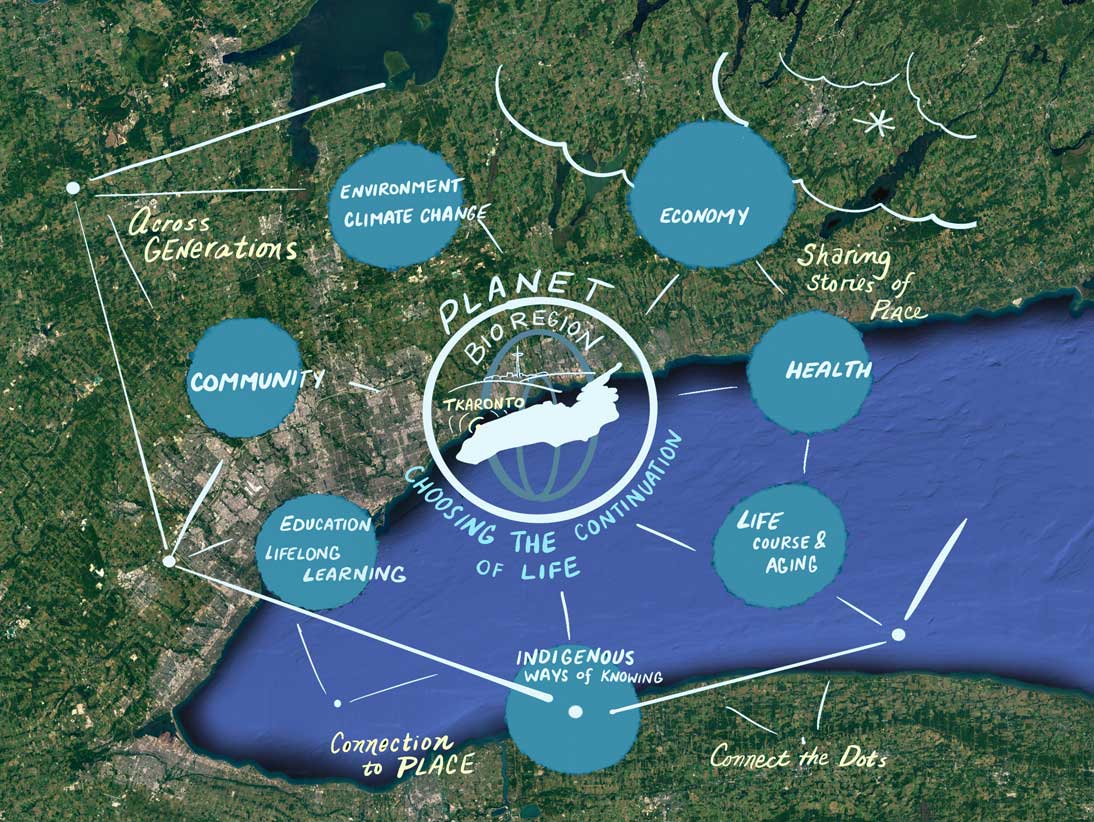
We recognize that both the scope and scale at which we address current challenges are critical. Based on earth systems science, a bioregion is the smallest actionable scale reflecting the planetary system.
To catalyze and inform action in a bioregion, and give that action more meaning over the long term, each bioregion needs a Bioregional Learning Center (BLC). The BLC is guided by the principles of the Earth Charter while being grounded in a specific place/bioregion.
The GTB Bioregional Learning Center is both a centralized and decentralized entity that creates coherence for learning about our place.
GTB STRUCTURES AND PROCESSES

7-Generation GTB is organized by the land; the land anchors and brings coherence to the structures and processes we're creating.
The three key structures are a Bioregional Learning Center (the keystone structure), a Portfolio of Projects (featuring landscape regeneration), and a Bioregional Foundation (which supports a funding ecosystem, regenerative economy, and alternative governance).
Three processes flow between the structures: nurturing intergenerational relationships, through which we all see ourselves as elders-in-training reaching for collective wisdom; collaborative sensemaking (which includes psychological flexibility, complexity thinking, creativity) and collective action; and ecopsychosocial healing, which includes intergenerational trauma.
The Portfolio of Projects brings together fragmented, decontextualized activities in the bioregion (into what we're calling Legacy Projects). It enables us to practice new local approaches so that they eventually become widespread practices. It makes existing and new regenerative projects visible to each other and the community; enables a holistic evaluation of needs and priorities for integrated landscape planning and multisolving; supports coordination and cooperation for whole-system social and ecological regeneration at the bioregional scale; enables mutual learning across projects; and multiplies effort through synergies.
The Bioregional Foundation manages regenerative value flow and governance in a bioregion. It models regenerative economic structures around what we value and stewards a bioregional funding ecosystem to support our bioregional values. The funding ecosystem enables regenerative projects and mobilizes resources – financial, social, natural – across the entire bioregion, while monitoring and evaluating progress. It also convenes local groups/organizations/projects and enables meaningful participation in decision-making, improving equitable environmental and socioeconomic outcomes for present and future generations.
The Bioregional Learning Center is the keystone structure for (re)learning how to live in our place. The BLC is a community-facing learning lab for real-world resilience and inspiration, as well as social and ecological regeneration. It helps people better understand the geology, ecology, culture and history of our location on the planet, and come together in our place in the context of lifetimes across generations. It creates a coherent story of place and a shared bioregional identity. The BLC connects across sectors – from water, food, and energy to health, culture, livelihoods – and can do integrated modelling and simulations. It's the literal and figurative entry point for everyone to learn about the GTB and how to care for it – not only people who live in this place, but also newcomers and visitors.
BLC ORIGINS
The BLC concept emerged from ten years of meetings in the 1980s of some of the best minds in the world, the Balaton Group. The group was named for the lake in Hungary where they held their first meeting, and was led by systems scientist Donella Meadows who was the lead author of The Limits to Growth.
The Balaton Group explored the big question of how humans could live sustainably on the planet.
The answer took the form of a vision of a bioregional approach with centers "where information and models about resources and the environment are housed."
From the bioregional vision of Donella Meadows:
"There needs to be many of these centers, all over the world, each one responsible for a discrete bioregion.
They would contain people with excellent minds and tools, but they would not be walled off, as scientific centers so often are, either from the lives of ordinary people or from the realities of political processes. The people in these centers would be at home with farmers, miners, planners, and heads of state and they would be able to both listen to and talk to all of them…
The centers collect, make sense of, and disseminate information about the resources of their bioregions, and about the welfare of the people and of the ecosystems. They are partly data repositories, partly publishing and broadcasting and teaching centers, partly experiment stations and extension agents. They know about the latest technologies, and the traditional ones, and about which ones work best under what conditions.
They are able to see things as a whole, to look at long-term consequences, and to tell the truth. They are also able to perceive and admit freely where the boundaries of the state of knowledge are and what is not known. Above all, the job of these centers is to hold clear and true the context, the values, the ways of thinking, through which all development plans and resource management schemes proceed."
Wraps up Meadows, "This will take years, but [the centers] have the potential to transform the way people all over the world think about their resources and their options."
FOR OUR TIMES
Global regeneration leader Joe Brewer believes that one of the most important parts of bioregional social and ecological regeneration is organizing a learning ecosystem that coherently integrates everything taking place in the bioregion.
Joe comments on the Bioregional Learning Center concept: "In these centers, there must be ways to retain and pass on practical knowledge about native species, understanding how to build homes in the local climate using locally-sourced materials, comprehension of what it means to have sustainable food systems in this particular place, complexity thinking, prosocial skills, and incorporation of the performance arts that cultivate sacred relationships with local ecologies in respectful and persistent ways… Bioregional learning centers around the world learn from each other." Hear more in this introductory BLC video:
A THIRD WAY
In the context of the GTB as part of Canada, we must continue with the process of truth and reconciliation – and go one step beyond to weave together holistic Indigenous knowledge systems with the best of Western scientific thinking to find a "third way" forward. A
Dr. Dan Longboat is an Associate Professor in the Chanie Wenjack School for Indigenous Studies at Trent University. He and Joe Brewer recorded a conversation around the importance of bringing together Indigenous and Western ways of knowing.
Says Dr. Longboat, "One of the things that's really central in engaging with different perspectives and different knowledge systems, in how they interact, is the idea of sacred space; it is really about ethical space. Within our context of it as Haudenosaunee, whenever individuals or two things come together to make an agreement, whenever they collaborate… then the space in between them is the sacred space; you can kind of think about it in terms of how they are respectful towards one another, how they are caring and compassionate towards each other, how they are empathetic with one another… We [Indigenous peoples and settlers] are both sailing down the river of life together. And our responsibility is to help one another, but more specifically, the river of life is in danger right now and there will be no more river of life. So, it behooves us now to utilize our knowledge together to work to sustain, to perpetuate, to strengthen the river of life. Why? So that all life will continue. And at the end of the day any social innovation or systems stuff should be all about the continuation of life and however we understand it to be – not just human life but all of it, for this generation right to the end of time."
The GTB BLC can be a powerful 7-Generation space bringing together ways of knowing to put life at the center of every choice and action.
LEARNING ACROSS THE BIOREGION

The GTB Bioregional Learning Center is both centralized and decentralized, a structure of relationships that "centers" bioregional learning. We envision it like a flower. The main site for the GTB BLC is
 Through schools, we've created an intergenerational zone that brings generations together to learn from and with each other in the real-world context of the community, and take collective action on regenerative Legacy Projects. We emphasize a land-based approach. Intergenerational teams consist of a student EcoLeader, an enthusiastic teacher (and often supportive parents), and an Elder-in-Residence. These core teams ripple out engagement through neighbourhoods.
The school intergenerational zone draws on the ethos of The Intergenerational School (TIS), a public charter school in Cleveland, OH. It was co-founded by Dr. Peter Whitehouse, who is part of the Group of Seven advisors for the
The BLC is also drawing on existing programs in local universities and conservation authorities, together with field sites like regenerative farms. We can co-create, across generations, a compelling and grounded story of our bioregion which powerfully translates into collective action through both social and ecological regeneration.
Here's a sampling of the 7-Generation GTB Bioregional Learning Center network (we're continuing to grow this network):
Waterfront Regeneration Trust and Great Lakes Waterfront Trail – This amazing trail reconnects people to the water and is a catalyst for improvements in many of the communities it interconnects. The Trail is a powerful opportunity to be on the land in the GTB, for a quick stroll or a multi-day, long distance adventure. "The essence of greenways is connections – not simply connecting recreational areas through trails, but connecting wildlife habitats to each other, human communities to other human communities, city to country, people to nature."
Toronto and Region Conservation Authority (TRCA) – The largest conservation authority in the GTB and the largest provider of outdoor education in Canada. Across its watersheds, TRCA hosts webinars and e-learning activities, guided hikes, festivals and other seasonal events, educational workshops, and public consultations.
Toronto Nature Stewards (TNS) – Centering stewardship of ravines and natural areas in Toronto, TNS's vision is healthy, biodiverse ecosystems where plants, animals, and humans can thrive together. Stewards support ecological restoration by picking up litter, removing invasive plants, planting native species, and monitoring the ecological impact of stewardship activities. Each stewardship site has been approved by the City of Toronto and each group is committed to stewarding their site for a period of several years. TNS also provides evidence-based stewardship training and resources to private property owners and community volunteers.
York Regional Forest – Over 2,500 hectares, made up of 24 Forest Tracts located in different parts of York Region. More than 150 km of trails. Outdoor education programs connect all ages with nature. The Bill Fisch Forest Stewardship and Education Centre is one of the most sustainable buildings in Canada, with LEED Platinum certification, and is the first Living Building Challenge project in the country.
Rouge National Urban Park – Canada's largest at 7,900 hectares. This natural environment is easily accessible from the city. It includes forests, creeks, farms and trails as well as marshland, a beach on Lake Ontario, and human history spanning over 10,000 years. You can explore on your own, enjoy a free guided walk, and even take a virtual hike on one of several trails.
Myseum – Offers experiences that tell the stories of Toronto history. Millions call the GTB home. It contains many histories. It changes by the hour. By inspiring curiosity and sharing stories, we foster deeper relationships between people and place.
Markham Public Library – We're working with the eight branches of MPL across Markham on a Generations Dream community process and Elders-in-Residence to connect generations into bioregional experiences.
York University – We're working with Dr. José Etcheverry on creating local park experiences to help people of all ages understand meaningful actions they can take in the GTB.
Ontario Woodlot Association – OWA bridges the gap between agriculture and forestry. They define "woodlot" to mean any private or community-owned treed property including all woodlands, wetlands, and forest-forming habitats. The term "forest" is used to describe the larger treed landscape. OWA is currently running pilot projects exploring regenerative approaches for both farms and forested areas.
LEAF – LEAF (Local Enhancement and Appreciation of Forests) is a non-profit organization that teaches people about trees and gets them excited about the urban forest. They plant native species in backyards and public spaces while engaging citizens in urban forest stewardship through planting, education, and training.
Toronto Black Farmers – Growing clean food, building community, and helping others learn about regenerative practices. Founded by Jacqueline Dwyer and Noel Livingston. Jacqueline is a passionate community organizer and farmer. She wants to see all generations in the African diaspora realize food sustainability. Noel is an urban farmer, musician, and food agro processor. He's focused on community development, food justice, and the continued growth of a healthy African family and community initiative.
Blue and Silver Farm, Pickering College – Charles Boyd was a teacher, coach, mentor, advisor at Pickering College (PC) for over
Heartwood Farm & Cidery – A regenerative 42-acre farm with fresh air, good soil, healthy plants and animals, and a lively kitchen table. You're invited to the conversation. They offer overnight farm stays, educational programs, and a store. "We like to say we're in the business of transformation. We enliven and awaken people by showing them the connections between all the things that make up a good life: sunlight to plants, grass to meat, fruit to juice, sap to syrup, cider to conversation."
To learn more about the local bioregional context, check out the
Are you interested in being part of the GTB Bioregional Learning Center – as a site/program, student, elder, teacher, land steward?